Commissioner Race – Glaring Policy Contrasts

Below are 5 of the most glaring contrasts between the incumbents and myself. There are many more. These are just the most obvious. This election is a clear choice. By attempting to pull the focus off these issues, the incumbents are playing little political games. These are the issues that matter to residents.

Land development/Growth issues

1. Jaindl - The grandaddy of terrible decision making. Dissected at length over the last 2 years and deservedly so. No need to re-hash here. For those who want to read in depth my thoughts visit here. One decision that will change the tone of the township forever. Residents never had a voice in quarry vs. over 1 square mile of warehousing once the awful MOU was negotiated. The incumbents chose the urban industrial path vs. the rural quarry path. (Quarry = 1/10th of the truck traffic)

More:
Transperancy LMT style

2. Allen Organ upzoning/conflict of interest - Here is the elevator sypnosis: Weis wants to move across the street to new store with gas-pumps. Weis thinks they can then compete with the Wegmans and Giants of the world. Ok that is fine. No problem with a private business doing what they think they need to do to improve business. They have every right to do this since previously the parcel across the street was zoned commercial. Supermarkets are allowed in C-Commercial.

Now….Fast forward a little bit. A developer wants to facilitate project. The developer can’t make money off of just building a supermarket on this parcel with it’s many constraints that make it tough to develop. (railroad, floodplain, limited frontage) So developer asks board of commissioners to change the rules so they can also build up to 250 apartments. This way the developer can make money. So board unanimously rubber stamps a bran new zoning ordinance that will allow developer to shoehorn a supermarket and apartments on a small parcel. A parcel with one major entrance/exit that will create traffic nightmares on Rt. 100. The realtor on the property? Happens to be our very own president of the board of commissioners who will cash a hefty commission check off the deal.

More:
Supermarket and up to 250 apartments proposed with new zoning ordinance.
LVPC comments on Allen Organ Plan 

Solutions: How do we do better?
Cost benefit analysis of re-zoning
Transferable Development Programs.

Refusal to deal with traffic concerns

3. A Police Department to solve traffic concerns (which would equal a massive tax increase that I do not want) is NOT the answer. The answer is traffic calming measures. Such as the ones outlined here and here. The board has consistently refused to even explore these options. Now that we’ve set ourselves down a certain path thanks to decisions by the current board we need to consider these measures to control traffic and speeding issues. Traffic calming and walkability go hand in hand

Pennsylvania’s traffic calming handbook

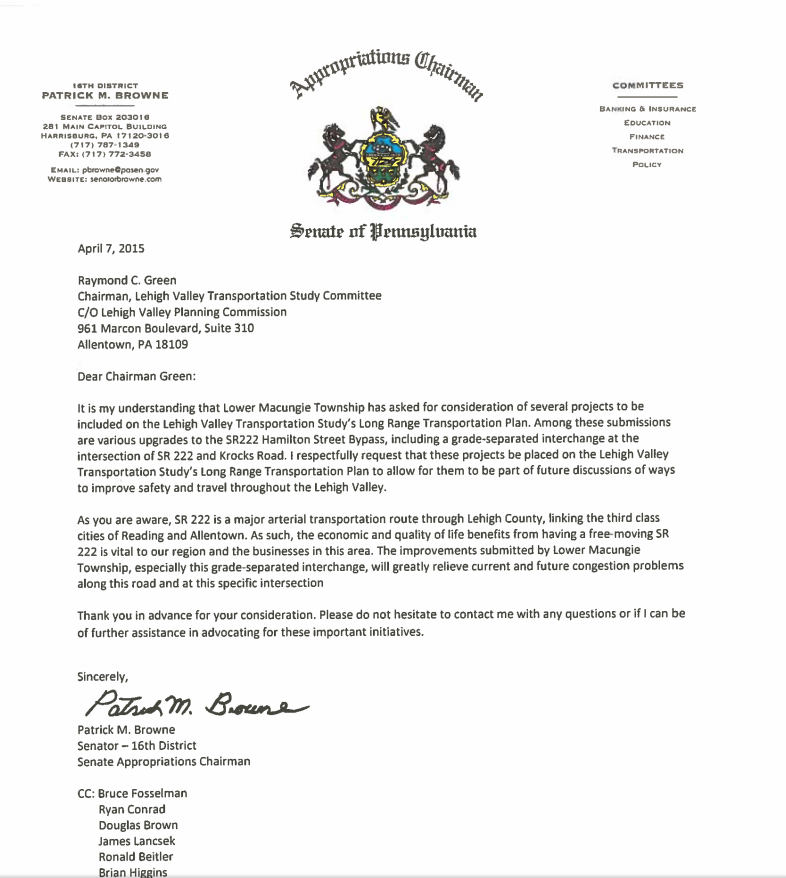
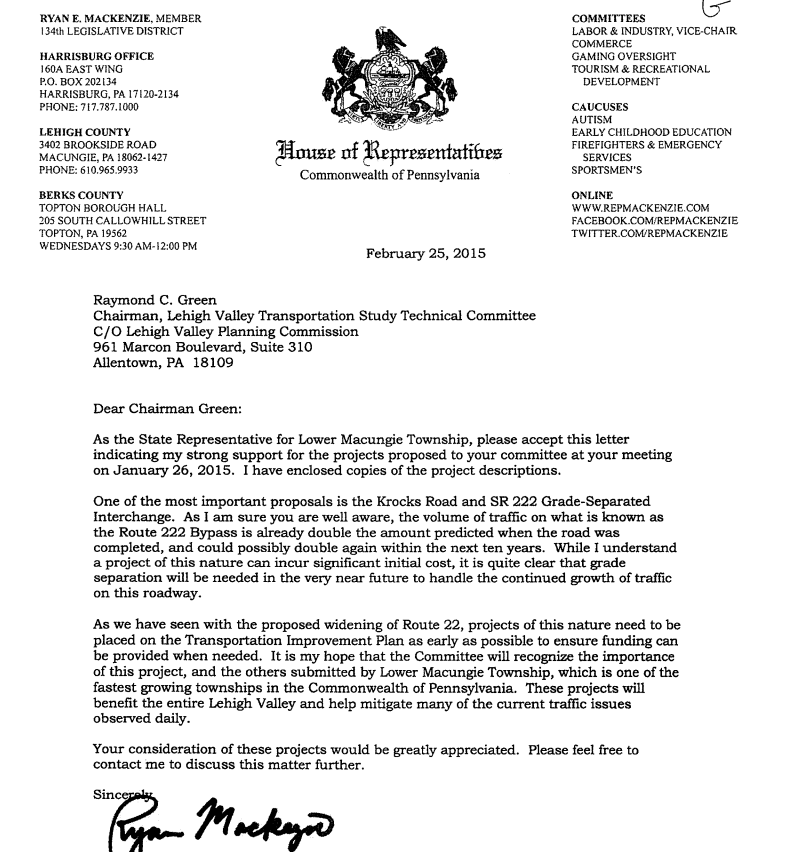
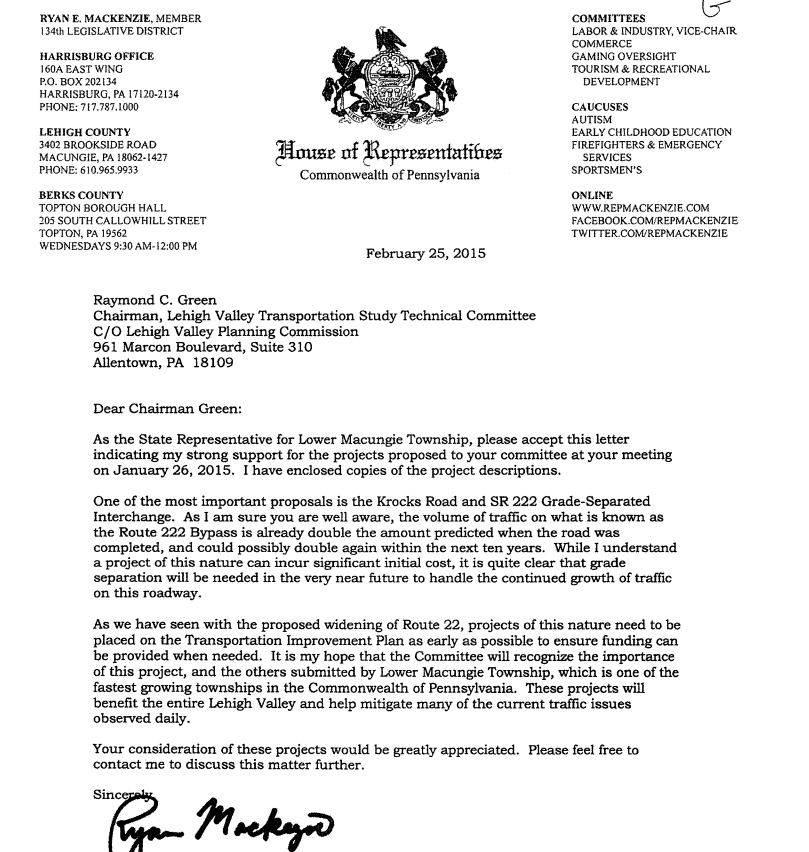
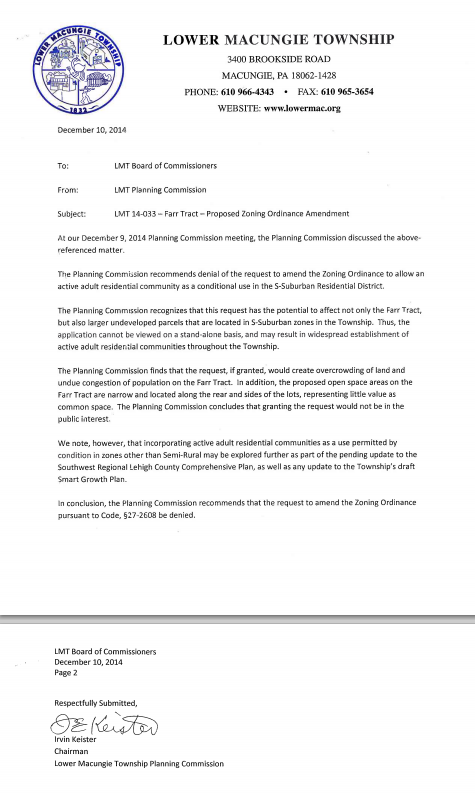
Next, truck traffic. Decisions were made to go all in on warehousing. So now what? Now we need bandaids. Instead of beefing up signage and implementing no truck zones to funnel traffic to safe routes getting them to the highways safely and quickly the board does nothing. “We don’t want to stop commerce” – Roger Reis. I do not get this statement, no one wants to stop commerce. We want to stop trucks from using local shortcuts through residential areas. These trucks are not going from warehouses delivering to our local community. What they are doing is cutting through to get to the highways. We’ve gone all in on warehouses and not we have to deal with consequences and stop burying our heads in the sand. We also must prepare for the next “bypass of the bypass” project and others like it that will cost the taxpayers dearly for terrible decisions over the past 3 years.

Over-regulating homeowners and small business

4. Three examples of new regulations the current board has indicated will pass or already passed.

A. As part of the new Act 537 sewage plan, mandatory inspections of on site sewer systems will be required every 2 years. This is regulating household maintanence. Classic regulatory overkill.

B. New mandatory inspections of all of Lower Macungie’s business owners next year may have to pay for an annual fire safety inspection of their buildings. As a small business owner, I do not believe in imposing additional costs on small businesses.

C. New Tree harvesting regulations limit the amount of trees a private resident can cut down on their property. Two parts to this, first the commercial aspect of this ordinance is great. However, I think the residential limit of certain number of trees in one year was too intrusive.

Preservation of our character.

5. There is no more bigger issue moving forward then managing growth. The biggest recent example was a missed golden opportunity to explore taking land preservation out of the hands of politicians and putting it into permanent preservation mechanisms. The Kratzer farm is the prime example. 88 acres of farmland and open space in a central location providing a positive benefit to 1000s of adjacent homes. For the some reason the board refuses to apply it to the county easement program. (A program voted on and passed by county voters 2-1) 

Additional questions from LWV candidates night

I asked the League of Woman Voters for copies of questions we weren’t able to get to that were submitted at the candidates forum. Here are my answers to about half. I will post my answers to the second half next week. I’m inviting my opponents to do the same so that all the questions from the night can be answered.

What is your occupation?

I’m a local small business owner. My two business partners and I went to high school together. All three of us grew up in the area. Our business is a wedding entertainment, photography and film company. We primarily do weddings, but we also do all types of events including corporate, Bar and Bat mitzvahs and sweet 16‘s. Our film department also does some commercial work. We have an office on Main St. in Macungie. We’ve been in business for 3 years. Prior to starting the business I worked in Higher Ed. Administration.


Most residents agree that Jaindl “Plan B” is an improvement over the plan initially approved by the BOC. Do you think that Plan B would have been offered if there were no challenges and litigation?

No, ‘Plan B’ was the result of residents speaking out against the project. I can say that with absolute certainty. Without the litigation, there would be no plan ‘B’. With out plan ‘B’ we’d have double the houses, double the strip commercial, you’d have to drive through warehouses to get to the park and a wide interior road that will be pounded daily by tractor trailers (increasing the frequency of maintenance) would be the responsibility of taxpayers instead of the landowner.


Walmart is becoming a significant drain to our state police force and creating ever increasing crime statistics that is ruining the rural character of our quiet township. What steps would you immediately apply to force Walmart to correct this significant problem?

I believe businesses that become a consistent nuisance in terms of calls to police should be assessed an impact fee. I’m not sure what is and is not allowed in PA. I’ve reached out to Gary Cordner the gentleman conducting the police study about options.

Once we double the amount of warehousing in the western portion of the township you can bet it will add additional strain on police services. (yet another argument why quarry would have been better…) Just look at the number of calls certain distribution centers generate in Upper Macungie. Upper Macungie Township pays millions for police protection. This is a good question for the developer of the Costco and Target. I will be sure to ask how the developer hopes to alleviate the impact of calls to the state police for shoplifting and other petty crimes associated with a large shopping center.


Do you believe remaining open space in LMT should be made a priority to preserve? Such as purchasing development rights?

Absolutely. The answer is transferable Development Rights Programs. (TDR) This is one of the centerpieces of my platform and something I’ve advocated for at many township meetings. With a TDR landowners can voluntarily sell their development rights to another landowner or a real estate developer for use at another location. A municipality faciliates this by creating a land bank. This is a market based solution for land preservation. It’s voluntary. Landowners get compensated at market value. Developers can purchase density to apply it to appropriate locations and the community gets valued farmland/open space preserved. Everyone wins.


The township Act 537 sewer system requires on site sewer systems to be pumped at two year intervals. Do you believe this normal household maintenance should be regulated by the government? 

No. I do not. This is over-reacting and over regulating. I would consider a non-intrusive inexpensive visual inspection at 5 year intervals but absolutely not a mandatory pumping. This shows a complete lack of understanding how these systems function. You can actually damage a systems by pumping it to frequently. Yes, we need a way to address malfunctioning systems. But 2 year inspections is over regulation at it’s finest. Major issues can be identified with a visual inspection of a drain field.

My position on the Kratzer Farm open space

Position Statement Kratzer Farm
Importance/overview: The Kratzer Farm is centrally located adjacent to the Village of East Texas. It’s strategic centralized location makes it readily accessible to thousands of residents easily and safely within walking distance. The park was purchased by a previous Board of Supervisors 15 years ago for the intent of land preservation in a rapidly growing township. The scenic landscape and fertile limestone soil make this a community treasure.The adopted greenway plan will further improve walking access and functionality of the park. The Kratzer Farm should be a destination, centerpiece and focal point of the greenway system preserved permanently as a nature preserve, passive park, community garden and working farm.

The Kratzer Farm – Township Owned Open Space strategically located in the center of the township

1. The house, barn and driveway should not be sold until the results of the Parks and Recreation comprehensive plan is complete. The farm specifically should be the focus of an agenda item at a future parks and recreation comprehensive plan meeting. The committee should be the body that determines whether the house, barn or driveway presents any value in regards to the overall goal of a permanent centralized large passive park.
2. The farm should be permanently preserved as soon as possible. To accomplish this goal:
A. The township should apply to sell agricultural conservation easements to the Lehigh County. The annual deadline for submitting an application is March 31st. According to a representative from the program the parcel would likely be valued a high priority since it contains fertile limestone soil. Currently the program is paying up to 5000/acre for preservation. I am estimating proceeds of selling the rights (the township still owns the property) could net up to 250,000 dollars.

Question & Answer – TIF Funding/Hamilton Crossings

Rec’d this question today. I thought it was worthy of a blogpost answer.

From Facebook - William DeMauriac - Ron, what is your position on spending tax revenue on any private project like the Hamilton Crossings?

1. My position is two fold. First. The development itself is a good project, but more importantly it’s in the right location. Aside from making development pay it’s own way with elected officials ensuring projects that receive waivers and exceptions provide the community an return on investment, smart growth is guiding growth to appropriate locations. Location is everything for this massive shopping complex. Costco will attract regional shoppers, the location is ideal since our interior residential roads will not be affected by non-local traffic.

Further, the developer Tim Harrison is community conscientious. And trust me, I’ve heard the song and dance developers give in front of our BOC and Pcom many times over the last 3 years. After personally sitting down with Tim last week I am confident he is genuine in his desire to build a project not only himself but the community can be proud of. He has shown a willingness to go above and beyond.

2. Secondly we have the funding mechanism. There are questions to be answered still. What will the terms be? As you know, the TIF committee meetings which consist of reps from the Twp, EPSD and County are occuring now an ongoing. I appreciate those including Percy Dougherty and others from the EPSD who requested these meetings be public. Unfortunately, that request was denied. The argument made was that developer finances will be discussed. I’m of the mindset that when seeking public funding, your finances become the business of the public.

Moving beyond that however, one of my personal goals is to encourage growth that does not rely on the taxpayer to shoulder burden. Elected officials should be questioning the terms and conditions of the TIF every step of the way and be willing to let the developer walk if the terms and conditions do not benefit the community from a lifecycle cost benefit analysis perspective.

Too often our elected officials in LMT are all too willing to give away something (waivers, exceptions, density, intensity) for nothing. This is a fundamental focus of my campaign. I’m not anti growth I’m pro smart growth. The fact that officials argue we still need economic development after 2 decades of robust growth is proof we’ve grown in an inefficient way. After two decades we should be in pretty good shape. To indicate we aren’t by claiming we need growth is fundamentally telling. It’s time to stop and evaluate the status quo. Win or lose I hope my candidacy will force that conversation.

Thanks for your question William.

Ron


Development Watch: Allen Organ Rezoning on agenda this Thursday.

Featured

The controversial Allen Organ rezoning is on the agenda for this Thursday’s Board of Commissioners meeting. The ordinance was advertised in January and will likely be voted on at the meeting.

Currently the 36 acre parcel is zoned commercial but has multiple unique constraints that make it difficult to develop without a special new zoning district. These include floodplain, location adjacent to a railroad and a dog-leg shape. To make the project economically feasible the developer has proposed a zoning ordinance that will allow up to 200+ apartments along with a 75,000 square foot supermarket with gas pumps.

Given past statements by current commissioners including board president Ron Eichenberg (who also happens to be the Realtor of the project) the ordinance is likely to be passed. I continue to have major concerns with the traffic impact on Rt. 100 and Willow Lane.  I do not believe we should be considering zoning change requests to expedite development in the western corridor of the township. We should instead concentrate on infilling the appropriate corridors such as areas surrounding Hamilton Boulevard and the By-pass. These areas can handle the traffic impacts of largescale development without the need for costly improvements and avoiding negative impact on the residential portions of our township.

What I would have advocated for differently:

One alternative is targeting tracts for preservation west of Rt. 100 using mechanisms such as a transferable development rights program. Here landowners can be fairly compensated for their property by selling development “rights” to other developers seeking enhanced, new or special uses, greater density or intensity, or other regulatory flexibility.

The Allen Organ parcel may have been a perfect candidate for such a program. We could have allowed this development to occur but only in exchange for preservation elsewhere. These programs are in place throughout the state. Everyone wins. The developer seeking more intense uses has options to acquire them, landowners who should be fairly compensated for their development rights are, and the community at large seeking to protect our quality of life has a mechanism to ensure it.

The key ingredients for a successful TDR program are all here; a strong real estate market; community consensus for conservation, and a community willingness to accommodate smart growth. All we need are leaders willing to explore these alternative options.

Op-Ed – Scott Alderfer Chair EAC – Residents didn’t cause polarization

Featured

Scott Alderfer chair of our townships EAC (volunteer position) wrote an op-ed last week about the perceived “polarization” of the township. Here’s the link.

I agree that Jaindl’s proposed Spring Creek development and questions surrounding the rezoning process have been polarizing. And Conrad seemed to try to vilify residents who exercised their First Amendment right to petition the courts for redress of their grievances relating to the township’s actions in rezoning Jaindl’s land. So it seems that the polarization has been created not by some residents suing the township but by the township commissioners preferentially listening to one powerful landowner to the exclusion of thousands of other township landowners who actually live in the township.

Further Scott gives more evidence to the fact that the Board solicited very little in terms of feedback from township volunteer bodies when negotiating the flawed plan “A”. I’ve also spoken to a former planning commissioner who expressed frustration at a lack of available information on exactly what was being negotiated in late 2009/early 2010 that resulted in the MOU to rezone hundreds of acres of prime farmland into industrial, housing and strip commercial.

I’m disappointed that these commissioners never asked their Environmental Advisory Council, on which I still serve, for its opinion on the rezoning. We would have advised that rezoning for development in the rural, western part of the township would be a catastrophic loss of open space and of the quality of life inherent in an agricultural district. We would have warned that removing the agricultural protection designation to allow development creates a dangerous precedent that could encourage other agricultural landowners to demand the same opportunity to cash in that was afforded to Jaindl. In fact, the township recently received a new request to do just that.


Why won’t township officials consider traffic calming measures?

It is by far and away the most frequent complaint the township receives. Almost monthly letters are read at BOC meetings written by frustrated residents dealing with speeding issues on their local streets. Many of these letters ask about speed bumps or speed tables. The answer the BOC usually gives is something ambiguous or vague to the effect of if they install one set they will get a request for more or something about creating more work for public works and plowing.

You cannot argue with the effectiveness of these measures that physically slow down traffic. It’s both a quality of life issue and a safety issue. Penndot actually actively promotes these measures via it’s “traffic calming handbook” publication.

The handbook outlines protocols for when traffic calming measures are appropriate. I’m beginning to research other policies local township governments in the state have in place for facilitating resident requests for traffic calming.

It’s been far too long elected officials have buried their heads in the sand regarding the fact that if they continue the growth policies they currently have in place they cannot avoid forever dealing with the negative by-products such as speeding issues, truck traffic and volume issues on our local roadways.

It’s like building warehouses without no truck zones on nearby local streets or allowing elementary schools to open without signage or 15 mph school zones.

See a pattern here? 

The past two presidents of the board have been Roger Reis and Ron Eichenberg. The President is responsible for framing issues and putting items on the agenda. There have been some major failures over the past two terms.


1/4 Allen Organ LVPC comments letter

1/4/13
Board of Commissioners,
I would like to encourage you to address the recent comments by the LVPC regarding the proposed Allen Organ Ordinance. I believe this is an example of building an ordinance to accomodate a sketch plan vs.  the best interests of the township. We must not compromise on interconnectivity simply because a site has unique constraints. (the creek, dogleg shape and the railroad) Sara and the Planning Commission have done a good job but this one issue still remains. I’ve commented on this in the past.
Here is why this particular comment is so important. It’s outlined nicely by the LVPCThe County Comprehensive plan has a policy of preserving arterial capacity by reducing local trips. When we force short local trips onto our arterial roads we create congestion. This leads an endless cycle of expensive “improvements” in attempting to increase capacity. This is nothing more then a perpetual band-aid.
I would encourage the board to read carefully the LVPC street connectivity guide. As well as other connectivity formulas that are out there as examples of how to address this issue. We must stop developing in isolated pods that dump the majority of traffic directly into single large arterial intersections. This issue needs to be addressed before passing this ordinance. The negative impact on Rt. 100 and Willow lane could be a major issue moving forward with the Remington Plan. Please remember, the carrying capacity of Rt. 100 also directly affects Macungie Borough where my business is located.
Respectfully,
Ron Beitler
5540 Lower Macungie Rd

Friends LMT response to commonwealth court decision

 We’re disappointed with the commonwealth court decision. Funding of this lawsuit was an overwhelming community effort by nearly a hundred individual donors making individual contributions ranging from 5 to 1000 dollars.Nearly a thousand residents signed the petition, multiple neighboring communities and smart growth advocates have condemned this zoning change as the antithesis of smart growth.

The details of the MOU (document allowing this travesty) were negotiated confidentially and decided unilaterally by seated commissioners without public input. By this action, the residents and neigbors of LMT were prevented from weighing in on the most significant zoning change in township history. A change affecting 5% of our township directly and all residents indirectly.

For now, the commonwealth decision is 22 pages and extremely complex. Moving forward the appellants will consider their options after the holidays. Friends will be open to supporting whatever decision they make. Remember, without overwhelming community support we wouldn’t have been able to stop this project. We sincerely thank all those who have put up a yard sign, contributed money, signed the petition or attended our events. The decision is ultimately the appellants but our organization stands ready to support the decision they make.

Ron Beitler - Outgoing Chair Friends for Protection of LMT

Friends LMT is a Smart Growth Resident Association. Our mission is to promote smart growth through education programs, advocacy and raising awareness. The past 2 years friends has supported the appellants attempting to overturn the Jaindl re-zoning to allow 1.5 million square foot of warehouses, Urban density tract housing and over a hundred thousand square ft. of strip mall just outside Alburtis on 700 acres of previously protected farmland. 

Join the conversation here on our facebook page www.facebook.com/friendslmt

Essential upgrades for walkable Willow Ln Elementary

Enhanced safety features ensure safe walking routes for students and parents at Willow Lane

Here are some enhanced safety features I think need to be considered before students are permitted to walk to Willow Lane Elementary next year. Here is a link to the walkability study conducted by PA safe routes to school. The study makes dozens of recommendations which in my opinion should be considered the bare minimal acceptable improvements to the 3 designated walking routes. I would like to see the following additional safety features considered by township and district officials in an effort to go above and beyond the bare minimum.

1. Lighted LED crosswalks similar to ones installed on Main. St. in Macungie.

Lights are embedded in the pavement on both sides of the crosswalk and oriented to face oncoming traffic. When the pedestrian activates the system by using a push-button, the lights flash warning motorists that a pedestrian is in the vicinity of the crosswalk ahead. These should be installed where appropriate at the busiest intersections.
Cost: Ranging from 5000-12,000 per system

2. Stalker Boards in conjuction with flashing 15 MPH school zone signage.

Stalker boards are electronic signs that display the speed of motorists as they drive past a point. Completely self contained these units are proven to significantly reduce speeds in school zones. These should be used in conjuction with flashing yellow lights and 15mph zones. (See photo)
Cost: Ranging from 6,000-10,000

3. Raised crosswalk/Pedestrian Medians

At crossing points where guards will not be located on connector roads and interior driveways on district property raised cross walks or pedestrian refuges should be installed as a traffic calming and pedestrian safety device.
Cost: Raised Crosswalk-$2,500-$7,000

To stay informed on upcoming township meetings where walkability is addressed “like” us on facebook! www.facebook.com/friendslmt