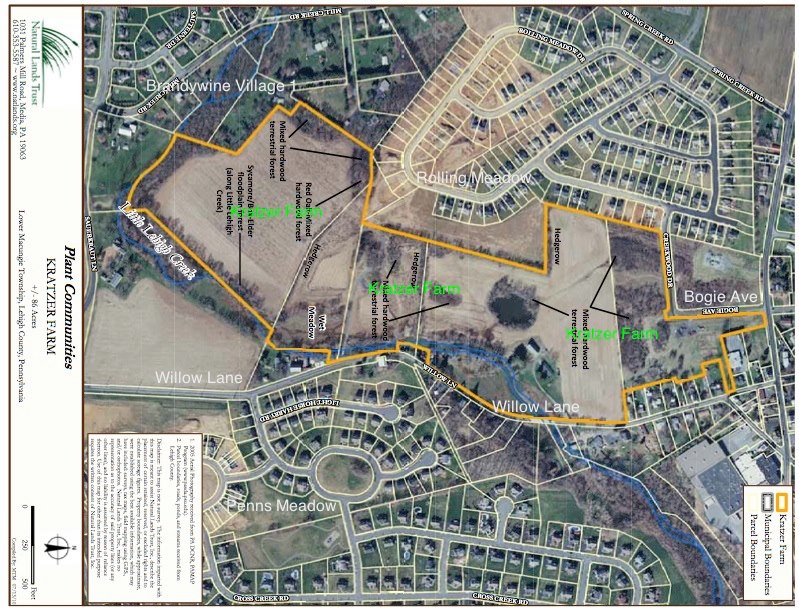
A. The township should apply to sell agricultural conservation easements to the Lehigh County. The annual deadline for submitting an application is March 31st. According to a representative from the program the parcel would likely be valued a high priority since it contains fertile limestone soil. Currently the program is paying up to 5000/acre for preservation. I am estimating proceeds of selling the rights (the township still owns the property) could net up to 250,000 dollars.
Growth issues: The key is Free market solutions for land preservation
At the ‘smart growth workshop‘ meeting this past Tuesday one of our volunteer planners said point blank that he ‘has concerns with the current board of commissioners being too accessible to developers.’ That the process has become “backwards”.
I tend to agree with this assessment and feel as though the Allen Organ project is the prime example. After having attended or watched every BOC meeting either in person or via webcast over the last 2 years I have witnessed this first hand.
Our current board is consistenly deferential to developers. Why? There is a difference between handing out gifts and landowner’s rights. Ron Eichenberg and Roger Reis the prior two presidents of the board who in turn speak for the board have and will continue to attempt to blur that important distinction in the upcoming election. The residents having a voice in the way we grow is consistently circumvented.
Yes, landowners have rights. That is a fundamental American value. I have personally advocated for protecting them. The solutions I have proposed are market based. Solutions such as transferable development rights programs. I can’t think of a solution more soundly grounded in conservative principle then one that solves our open space preservation issues with a market based solution.
As a commissioner I will not vote to hand out intensity/density without proper rationalization and due diligence. I will not allow a sketch plan to dictate a critical new zoning ordinance.
Free market solutions such as a TDR program will eliminate even the appearance of cronyism. If the township creates a mechanism for landowners to be compensated for development rights in addition for developers to be able to purchase intensity, then the appearance of cronyism when we simply hand it out for nothing is eliminated.
The landowner get fairly compensated, the township has a mechanism to guide growth to appropriate places and finally residents have a fair way to encourage open space preservation and protect our school district and our community.
LMT’s Wiki photograph soon to be extinct
Interestingly enough this bucolic countryside scene will be plowed over and replaced with a giant warehouse, maybe a parking lot for tractor trailers or perhaps a storm water retention basin. Hilltop Rd. connects with Mertztown Rd near the Butz-Leister farm.
Maybe it’s time someone submits a new photo for our wiki entry? Since this is the last part of the township that looks this the photograph does it really make sense anymore?
This scene may disappear and become extinct in the township. And it’s solely because of a choice made by our commissioners in 2010 including Roger Reis and Ron Eichenberg who are up for re-election on May 21st. I’m hoping folks remember this when they vote and consider replacing them.
Question & Answer – TIF Funding/Hamilton Crossings
Rec’d this question today. I thought it was worthy of a blogpost answer.
From Facebook – William DeMauriac – Ron, what is your position on spending tax revenue on any private project like the Hamilton Crossings?
1. My position is two fold. First. The development itself is a good project, but more importantly it’s in the right location. Aside from making development pay it’s own way with elected officials ensuring projects that receive waivers and exceptions provide the community an return on investment, smart growth is guiding growth to appropriate locations. Location is everything for this massive shopping complex. Costco will attract regional shoppers, the location is ideal since our interior residential roads will not be affected by non-local traffic.
Further, the developer Tim Harrison is community conscientious. And trust me, I’ve heard the song and dance developers give in front of our BOC and Pcom many times over the last 3 years. After personally sitting down with Tim last week I am confident he is genuine in his desire to build a project not only himself but the community can be proud of. He has shown a willingness to go above and beyond.
2. Secondly we have the funding mechanism. There are questions to be answered still. What will the terms be? As you know, the TIF committee meetings which consist of reps from the Twp, EPSD and County are occuring now an ongoing. I appreciate those including Percy Dougherty and others from the EPSD who requested these meetings be public. Unfortunately, that request was denied. The argument made was that developer finances will be discussed. I’m of the mindset that when seeking public funding, your finances become the business of the public.
Moving beyond that however, one of my personal goals is to encourage growth that does not rely on the taxpayer to shoulder burden. Elected officials should be questioning the terms and conditions of the TIF every step of the way and be willing to let the developer walk if the terms and conditions do not benefit the community from a lifecycle cost benefit analysis perspective.
Too often our elected officials in LMT are all too willing to give away something (waivers, exceptions, density, intensity) for nothing. This is a fundamental focus of my campaign. I’m not anti growth I’m pro smart growth. The fact that officials argue we still need economic development after 2 decades of robust growth is proof we’ve grown in an inefficient way. After two decades we should be in pretty good shape. To indicate we aren’t by claiming we need growth is fundamentally telling. It’s time to stop and evaluate the status quo. Win or lose I hope my candidacy will force that conversation.
Thanks for your question William.
Ron
Development Watch: Allen Organ Rezoning on agenda this Thursday.
The controversial Allen Organ rezoning is on the agenda for this Thursday’s Board of Commissioners meeting. The ordinance was advertised in January and will likely be voted on at the meeting.
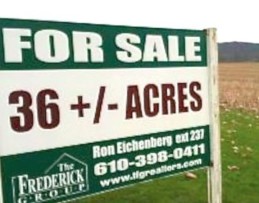
Currently the 36 acre parcel is zoned commercial but has multiple unique constraints that make it difficult to develop without a special new zoning district. These include floodplain, location adjacent to a railroad and a dog-leg shape. To make the project economically feasible the developer has proposed a zoning ordinance that will allow up to 200+ apartments along with a 75,000 square foot supermarket with gas pumps.
Given past statements by current commissioners including board president Ron Eichenberg (who also happens to be the Realtor of the project) the ordinance is likely to be passed. I continue to have major concerns with the traffic impact on Rt. 100 and Willow Lane. I do not believe we should be considering zoning change requests to expedite development in the western corridor of the township. We should instead concentrate on infilling the appropriate corridors such as areas surrounding Hamilton Boulevard and the By-pass. These areas can handle the traffic impacts of largescale development without the need for costly improvements and avoiding negative impact on the residential portions of our township.
What I would have advocated for differently:
The Allen Organ parcel may have been a perfect candidate for such a program. We could have allowed this development to occur but only in exchange for preservation elsewhere. These programs are in place throughout the state. Everyone wins. The developer seeking more intense uses has options to acquire them, landowners who should be fairly compensated for their development rights are, and the community at large seeking to protect our quality of life has a mechanism to ensure it.
The key ingredients for a successful TDR program are all here; a strong real estate market; community consensus for conservation, and a community willingness to accommodate smart growth. All we need are leaders willing to explore these alternative options.
Drinking water in LMT now Fluoridated
Since the city fluoridates it’s water, our drinking water supply here in LMT is now flouridated. For now, the concentration is less than in the city but this amount will increase as LCA continues to increase it’s water purchases from Allentown.
There has long been public debate over whether fluoridating the water supply is a good thing. It’s long been a contentious issue in the city since it began fluoridating in 2000.
Water Flouridation Controversy – Wikipedia article
The next Allentown water issue could be flouridation – Mcall
Another by product of the purchasing agreement is that LMT previously had mainly well water. Generally well water is considered a higher quality water source than surface water from a creek or reservoir. For years some including the ‘Friends LMT‘ organization have linked development pressure on the Little Lehigh creek watershed to the water supply quality in Allentown, since the city gets most of it’s water from the creek.
Now with the new agreement in place, LMT also gets it’s drinking water in part from the Little Lehigh Creek. Perhaps now this will open some eyes to issues surrounding the water quality of our watershed in relation to development pressure and policies by our current and previous boards that continue to put flooding, sediment and water quality pressure on the creek.
Op-Ed – Scott Alderfer Chair EAC – Residents didn’t cause polarization
Scott Alderfer chair of our townships EAC (volunteer position) wrote an op-ed last week about the perceived “polarization” of the township. Here’s the link.
I agree that Jaindl’s proposed Spring Creek development and questions surrounding the rezoning process have been polarizing. And Conrad seemed to try to vilify residents who exercised their First Amendment right to petition the courts for redress of their grievances relating to the township’s actions in rezoning Jaindl’s land. So it seems that the polarization has been created not by some residents suing the township but by the township commissioners preferentially listening to one powerful landowner to the exclusion of thousands of other township landowners who actually live in the township.
Further Scott gives more evidence to the fact that the Board solicited very little in terms of feedback from township volunteer bodies when negotiating the flawed plan “A”. I’ve also spoken to a former planning commissioner who expressed frustration at a lack of available information on exactly what was being negotiated in late 2009/early 2010 that resulted in the MOU to rezone hundreds of acres of prime farmland into industrial, housing and strip commercial.
I’m disappointed that these commissioners never asked their Environmental Advisory Council, on which I still serve, for its opinion on the rezoning. We would have advised that rezoning for development in the rural, western part of the township would be a catastrophic loss of open space and of the quality of life inherent in an agricultural district. We would have warned that removing the agricultural protection designation to allow development creates a dangerous precedent that could encourage other agricultural landowners to demand the same opportunity to cash in that was afforded to Jaindl. In fact, the township recently received a new request to do just that.
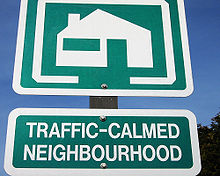
Why won’t township officials consider traffic calming measures?
It is by far and away the most frequent complaint the township receives. Almost monthly letters are read at BOC meetings written by frustrated residents dealing with speeding issues on their local streets. Many of these letters ask about speed bumps or speed tables. The answer the BOC usually gives is something ambiguous or vague to the effect of if they install one set they will get a request for more or something about creating more work for public works and plowing.
You cannot argue with the effectiveness of these measures that physically slow down traffic. It’s both a quality of life issue and a safety issue. Penndot actually actively promotes these measures via it’s “traffic calming handbook” publication.
The handbook outlines protocols for when traffic calming measures are appropriate. I’m beginning to research other policies local township governments in the state have in place for facilitating resident requests for traffic calming.
It’s been far too long elected officials have buried their heads in the sand regarding the fact that if they continue the growth policies they currently have in place they cannot avoid forever dealing with the negative by-products such as speeding issues, truck traffic and volume issues on our local roadways.
It’s like building warehouses without no truck zones on nearby local streets or allowing elementary schools to open without signage or 15 mph school zones.
See a pattern here?
The past two presidents of the board have been Roger Reis and Ron Eichenberg. The President is responsible for framing issues and putting items on the agenda. There have been some major failures over the past two terms.
Request to rezone on agenda Thursday
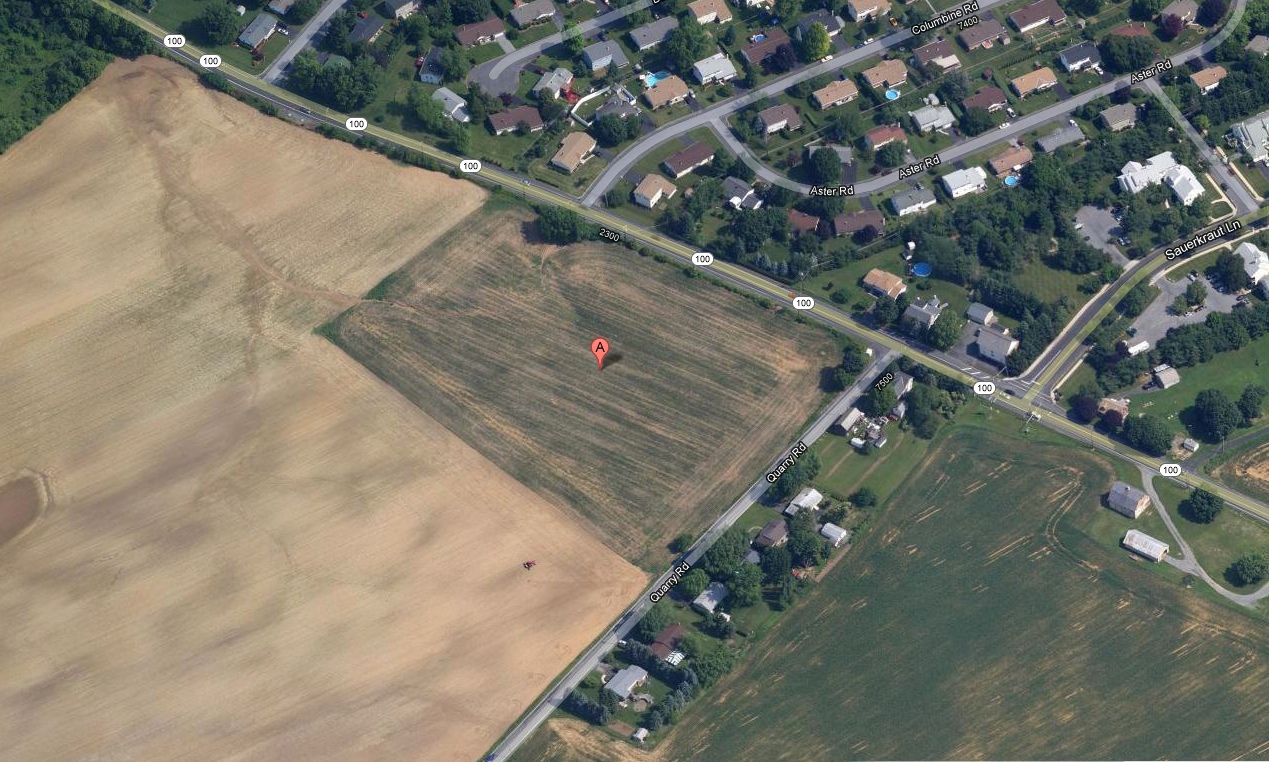
The public needs to be aware that a request to rezone 7513 Quarry Road will be under consideration to forward to the planning commission this Thursday. The item is on this weeks agenda. This is SEPARATE from the Jaindl issue. This is a large tract at Rt. 100 and Quarry Roads.
This large protected farmland parcel may very well be the first additional domino to fall as a result of the Jaindl rezoning.
The request is to change the zoning from Agriculture Protection to Commercial. This is a major step to transforming Rt. 100 into Macarther Rd with strip mall commercial properties along the entire corridor.
Residents who have concerns with this should make their opinion known. Commissioners have stated “they had no choice” in rezoning the Jaindl land. What will be their stance on this property?