Lower Macungie Commissioners Agenda Preview 4/3/14

FYI –  In these previews I may indicate thoughts on an issue, but it in no way means my mind is set. During a critical hearing for the Jaindl issue, a Commissioner spoke before public comment outlining he was voting to move forward the project regardless of what people said during public comment. That was wrong. Public debate was circumvented when the Commissioner indicated his mind was made up.

My hope is by blogging I open the door for conversations. One of my biggest issues with the Jaindl debacle was folks didn’t truly understand what was happening until it was “too late”. I plan on doing everything I can to make sure residents have background information on issues. This is one mechanism to do that. I hope people find it useful. Please contact me at ronbeitler@gmail.com if you have any questions or concerns about any issues.

Township Board of Commissioners 4/3/14 – Agenda with detail here

Continue reading

Lower Macungie Commissioners Agenda Preview 3/20/14

FYI –  In these previews I may indicate thoughts on an issue, but it in no way means my mind is set. During a critical hearing for the Jaindl issue, a Commissioner spoke before public comment outlining he was voting to move forward the project regardless of what people said during public comment. That was wrong. Public debate was circumvented when the Commissioner indicated his mind was made up.

My hope is by blogging I open the door for conversations. One of my biggest issues with the Jaindl debacle was folks didn’t truly understand what was happening until it was “too late”. I plan on doing everything I can to make sure residents have background information on issues. This is one mechanism to do that. I hope people find it useful. Please contact me at ronbeitler@gmail.com if you have any questions or concerns about any issues.

Township Board of Commissioners 3/20/14 – Agenda with detail here

Continue reading

RIP Lower Macungie Patch.

This morning I finally took the Lower Macungie Patch off my social media feeds.

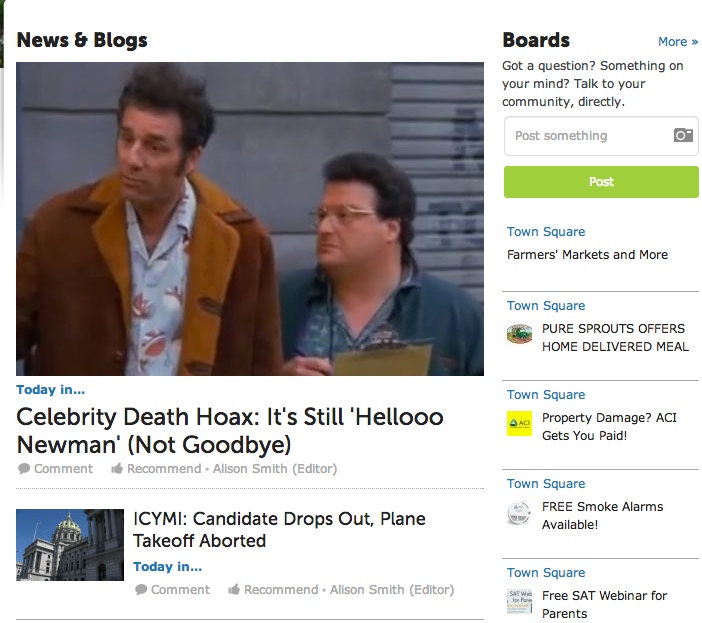
Since AOL completely fumbled the once promising venture, today it’s no more than a tabloid. Gone is the unique hyper local content generated by local editors and bloggers who were from the communities they served. We now have crickets on the local boards. The headlines consist of the kind of stuff you  find on TMZ and supermarket tabloids.

Very sad. Had high hopes for Patch. Seemed like we had 3 of the more successful ones locally in Emmaus, Upper Macungie and Lower Macungie. At one time it was a website I visited daily. When patch was cookin on all cylinders it provided an important service keeping residents informed on what was going on locally and providing a robust platform for neighborhood conversation and interaction. Content covered local gov’t, schools, neighborhood news, community events ect. Now it’s pretty much your standard celebrity gossip and national human interest stuff.

The local uniqueness is all gone now replaced with generic  content you can get on 100 other sites that are better put together.

Celebrity gossip and spam. What once was a very promising hyperlocal news website was completely fumbled by it's parent company.

Celebrity gossip and spam. What once was a very promising hyperlocal news website was completely fumbled by it’s parent company.


Lower Macungie meetings now viewable on youtube.

We’ve had webcasts for awhile now in Lower Macungie, but the prior delivery method was unstable on some OS systems (I always had trouble on macs) and also was it  hard to fast forward and rewind and the feature sometimes didn’t work at all.

Starting this year the township has been uploading and archiving videos on a new youtube channel.

This accomplished two things:

1. Fast forwarding and rewinding is now alot easier so when referencing a corresponding agenda residents can find the topic they are looking for without having to watch the whole meeting.

2. You can now quickly find and reference past meeting videos archived on the townships youtube channel.

Also on this website, I maintain an archive of my meeting previews, links to the agenda detail and meeting videos organized chronologically


Lower Macungie Commissioners Agenda Preview 3/6/14

Sorry this is late this week… I’ve been down with a cold!

FYI –  In these previews I may indicate thoughts on an issue, but it in no way means my mind is set. During a critical hearing for the Jaindl issue, a Commissioner spoke before public comment outlining he was voting to move forward the project regardless of what people said during public comment. That was wrong. Public debate was circumvented when the Commissioner indicated his mind was made up.

My hope is by blogging I open the door for conversations. One of my biggest issues with the Jaindl debacle was folks didn’t truly understand what was happening until it was “too late”. I plan on doing everything I can to make sure residents have background information on issues. This is one mechanism to do that. I hope people find it useful. Please contact me at ronbeitler@gmail.com if you have any questions or concerns about any issues.

Township Board of Commissioners 3/6/14 – Agenda with detail here
Continue reading

A way to reduce primary residence taxes. Homestead exception.

Originally Posted March 6, 2014

Last weekend I wrote about factors that forced Lower Macungie to address a budget shortfall this past December. This week I want to focus on one practical mechanism I proposed as a candidate and formally in January that could help address this issue moving forward.

First, it’s important to acknowledge a structural barrier that limits how a township like Lower Macungie can respond to the impacts of sprawling commercial and industrial growth. That challenge will only intensify over time.

Different land uses create different impacts and long term liabilities. However, Pennsylvania’s Uniformity Clause prohibits local governments from taxing residential and commercial property differently unless a specific statutory exception applies. As a result, municipalities cannot directly account for new impacts created by certain types of development through the tax code. This constraint is especially problematic in a township with a large and growing inventory of distribution warehouses that generate substantial infrastructure, public safety, and quality of life demands and may ultimately drive the need for additional police or fire facilities.

This is where smart growth principles come into play.
Greenfield development should pay its own way. Local governments must be vigilant against direct or indirect taxpayer subsidies for land use patterns that fail to generate sufficient revenue to cover their long term liabilities. Too often, municipalities negotiate one time developer improvements or fees without fully accounting for ongoing maintenance and replacement costs over multiple infrastructure life cycles. That approach is both shortsighted and fiscally unsustainable.

Property taxes are also fundamentally regressive.
Regressive taxes are harmful because they place a heavier financial burden on those with the least ability to pay, making it harder for working families and fixed income residents to remain financially stable. Property taxes are inherently regressive. They aren’t based on income, consumption or ability to pay. The property tax often consumes a larger share of household resources for seniors, fixed income residents, and working families. As they continue to rise they can contribute to housing affordability. This is compounded in our area because property values which drive assessments are rising faster than wages or retirement income. When this happens the tax burden grows even when a household’s financial situation does not.

A solution?
A local homestead exclusion is one of the few tools available to municipalities to address this imbalance. In simple terms, it works by lowering the portion of a home’s assessed value that is used to calculate local property taxes. When the taxable value goes down, the tax bill goes down. Because the reduction applies to a fixed amount of assessed value, the benefit is proportionately more meaningful to homeowners with lower or moderate property values and to those on fixed incomes. This helps stabilize housing costs while avoiding shifting the burden of supporting high impact land uses like warehouses onto residents and ensuring homeowner relief is targeted rather than universal.

A local homestead exclusion is a specific exception to Pennsylvania’s Uniformity Clause. It allows a township to provide relief to homeowners. It results in a lower local property tax bill for qualifying homeowners.

This relief applies only to owner occupied primary residences. It does NOT apply to commercial properties, 2nd homes, or investment properties. These properties continue to be taxed at their full assessed value. This ensures that tax relief is focused on people who live in the community full time while maintaining the full contribution from land uses that create the greatest long term impacts and costs.

There are 7 municipalities in Montgomery County who utilize this program on the local level. One example is Upper Gwynedd. An exclusion allows for real property tax relief of up to one half of the median assessed value of homesteads in the taxing jurisdiction. For example:

  • Under LMT’s current .33 mil property tax if you own a home at the township average of around 250,000 dollars your tax liability is 82.50. (Remember, this is the local Lower Mac property tax NOT school or County)
  • Under a homestead exclusion program that grants a 50% assessment reduction on a primary residence the assessed value (for purposes of tax calculation only) is cut in half to 125,000. Therefore the tax bill is also reduced by half to 41.25.
  • Meantime Commercial properties such as a distribution warehouses valued at 24,000,000 pays the full assessed value at .33 mil which would be 7,900.00 dollars.

Its reality that certain types of land uses like strip malls and distribution warehouses hurt quality of life and command the most resources. This is exacerbated when they are located on sprawling former agriculture fringe parcels such as the Jaindl Spring Creek Property which will unfortunately require bran new roads, infrastructure and improvements. Even portions initially funded by the school district and developer will have to be maintained in perpetuity by the township representing an ongoing liability. To me it’s a matter of fairness. Land uses that cause impacts are the ones that should pay for the impacts.

I have asked the Board of Commissioners to consider a homestead exclusion program as one way to reduce the tax burden for primary residences and farmland within the township. This would also allow us to right size taxes on commercial and industrial entities to make sure they are “paying there own way” so that residents aren’t forced to indirectly subsidize them.

The Quiet Boom and Bust of PA Townships

The following appeared in an op-ed this AM in The Morning Call. I wanted to re-post as it succinctly sums up the reality Lower Macungie recently began to face with a tax increase in response to a budget deficit. I’m hoping we continue serious discussions about how got to this point and what we can do to keep taxes sustainably low over the long run proactively. The alternative is reacting to shortfalls and never addressing underlying issues.

To do this it’s important we understand how we got to where we are. This post is a preface to a post I’m doing later on in the week where I’ll outline some items I think are a part of the solution. This post deals with how we got to where we are. 

By Gerald E. Cross – Pennsylvania Economy League.

Since the 1970s, Pennsylvania’s cities have grabbed headlines as they sank into a financial morass while the state’s townships quietly prospered.

But recent data indicates that the once booming townships – where almost half of state residents live – are also seeing troubling signs including rising service costs and tax revenue that is either declining or flattening.

The challenge for townships may soon be the same issue facing distressed cities: how to provide quality services at a price that taxpayers can afford. By recognizing that challenge now, townships can begin to implement measures to avoid severe financial problems in the future.

Pennsylvania Economy League research clearly shows the explosion of tax revenue collected by townships beginning in the 1970s as residents fled the cities and took their wealth to townships.

For well over 30 years, Pennsylvania’s third-class cities experienced an exodus that dropped population by almost 20 percent. In contrast, population grew by almost 50 percent in second class townships, where residents moved to take advantage of new housing developments.

As people left the cities, income from taxes began to decline. Meanwhile, townships were increasingly able to capture additional revenue as both population and the earnings of that population expanded.

Real estate tax collection and real estate transfer taxes in townships jumped from the development boom. Officials in these communities had the advantage of revenue increases that were the result of natural growth rather than a politically sensitive property tax hike.

In addition, escalating earned income tax revenue contributed an increasingly larger amount to township budgets so there was less need to rely on property taxes, in contrast to cities, where property taxes are the dominate source of tax dollars.

Cities not only lost earned income taxes from those who left – many of whom were higher income residents – they also saw declining revenues as the remaining population aged, retired and no longer had to pay earned income taxes.

Meanwhile, as populations moved from urban areas, the taxable property values in cities did not increase at the same rate as the townships, and in some cases decreased. Cities were also hurt by the lack of readily developable land that limited easy expansion of the property tax base. The result was a decline in property tax dollars. Revenue sources are not the only difference between cities and townships. Cities spend the bulk of their money on public safety costs including police and fire protection. In some cities, total tax revenue alone has failed to keep pace with the cost of police and fire expenses. 
Townships spend more of their money on roads and public works. Still, township spending on general administration and police has increased, indicating possible problems down the road if revenues stagnate.

The trend can already be seen. Earned income tax in townships peaked just prior to the 2008 economic crash and is now either declining or leveling off. Real estate transfer revenue crested in 2005 and 2006. Townships that heavily relied on those tax sources to increase services and avoid a property tax hike may now have to look to other revenues.

To meet the challenge of sustaining public services, townships should explore more regional options to both provide and pay for them. By recognizing the fiscal trends, townships can work now to implement corrective actions in an attempt to avoid the dire financial predicament currently faced by Pennsylvania’s cities.


The above scenario has played out in Lower Macungie. The past 20 years we’ve artificially kept taxes low through hyper growth. This year for the first time we faced our new reality of a capital budget deficit and spent reserves. The simple truth is we’re slowly but surely running out of space to plow and we no longer can rely on the windfall one time revenue of growth.

For decades we lived in a fantasy land of a bloated rainy day fund and one time windfalls. Fast forward to today: The one time revenues we’ve relied upon are dried up. We’ve peaked on the EIT front. Real estate transfer will see a small increase as the economy picks up but never will we again see the windfalls of the 90’s. We’ve got the 10,000 lb gorilla of police coverage. Whether 5 or 10 years from now someday we’ll have to address it. Our “rainy day fund” is now drawn down to near minimum acceptable levels. Developers who installed up front infrastructure have long since left town and it’s up to us to fund continuing maintenance and future improvements.


Add to this market factors. We simply aren’t currently positioned to compete for young professionals since they want compact walkable communities. The senior market is shrinking and we have a bloated inventory with more on the way.


We’re clearly at a crossroads and faced with a choice. Choice 1 is: Bury our heads in the sand. Shoehorn the last open space parcels in the township and continue to chase ratables, developer contributions and one time windfalls. Which in this new housing market equals low quality apartment complexes. But in the end it’s simply delaying and compounding the inevitable while simultaneously selling our quality of life down the flooding creek.
Choice 2 is:  Continue the tough conversations now and get creative. Think outside the box and figure out how we move this township forward delivering the services residents demand with a stable and predictable LOW tax rate.
This is now beyond quality of life concerns. This is about financial solvency moving forward. This is a preface to a blog I’ll write later on this week. I have proposed one possible solution that I’ll outline Thursday. Remember there is a no magic bullet but I think it can be a piece of the puzzle. Stay tuned.

Lower Mac Snow Emergency & Trash update for 2/12 storm

Snowstorm

A Snow Emergency will be in effect starting at 11 PM, February 12th, until further notice. All cars must be removed from Snow Emergency Routes or they may be towed. These Routes have permanent (red & white) signs indicating it is a Snow Emergency Route. As a courtesy, the Township may place temporary signs along Snow Emergency Routes today.

Lower Macungie Snow Preparedness Guide

Waste Management has notified us that they are not operating tomorrow, February 13th. Thursday and Friday trash/recycling collection will be on a one-day delay. DO NOT PLACE YOUR TRASH IN THE STREET. Please place trash where it will not be impacted by snow removal operations.

Roads within LMT are maintained by both the Township and PennDOT. Click here to see a list of PennDOT roads. Any concerns regarding a state road should be directed to PennDOT at 610-798-4280.

Click here for list of township and State Roads.

Some notes from LMFD: Click here to visit FB page.

Make sure  down spouts are free and clear of snow and ice. In addition, make sure that the run off has somewhere to go, so trench a path away from the house too. If your down spouts are all blocked up, the rain water will have no where to go and you run the risk of it entering your home.

Also do you have a hydrant on your property? Please don’t forget to clear out the fire hydrant on your property. 3 – 4 feet around the whole perimeter please. This is the responsibility of the homeowner with hydrant on property.

REMEMBER: There is often confusion about municipality folks live in. Remember, this information pertains to Lower Macungie Twp. If you live in Emmaus Borough, Macungie Borough or Alburtis Borough they each declare there own emergencies which or may not start and end different times. Your address may be one or the other but you may still be in Lower Mac. If your unsure ask! Message your address. Ronbeitler@gmail.com

Information about Emmaus Borough, Macungie Borough, Alburtis Borough.

Act 111 reform is needed in Pennsylvania

Last night, the Lower Macungie Board of Commissioners (BOC) voted unanimously to continue with Pennsylvania State Police (PSP) as our primary police provider. This decision came after conducting a comprehensive crime study. Results show we have the 7th lowest crime rate of Pennsylvania’s 35 largest townships. Our rate is 1/3 of Lehigh County’s average.

We have the luxury of basing a decision on data. We’re statistically a safe community and PSP does an outstanding job. Someday however, our community will have to address the method by which we secure coverage. This will happen either when A. crime data rises or B. state requires municipalities pay for PSP. This may happen in 5 years or it may happen in 20 years. No one knows.

Understanding some day we’ll face this decision we must consider all the factors involved. One of those factors is efforts to reform Act 111. Act 111 outlines how municipalities are required to negotiate legacy costs that make local police/fire departments financially unsustainable. 41 percent of Pennsylvania’s population live in municipalities facing fiscal distress. Local police/fire services are the single biggest cost item in many local budgets.

Act 111 arbitration awards contribute to escalating costs by handcuffing local governments. The act requires unions and municipalities to engage in binding arbitration during contract disputes. While the intent is good, the mechanism is 45 years old and needs reform. Act 111 gives unions unfair advantages – reaping large settlements that cost us all.

Until reforms are addressed as one member of the 5 person BOC I am wary about taking Lower Macungie down a path where issues like this are front and center where unelected outside arbitrators have so much power. Someday we’re going to have to address the potential of a local force. Until then it’s a concern that we don’t enter the township into a flawed system 

Here are two examples where Act 111 has led to financial stress and tax increases:

1. In 2013 after a 19 month Act 111 process paid for by Borough taxpayers, an unelected “neutral” arbitrator with no ties to the community rendered a ruling that forced Chambersburg to hike taxes. Here, Act 111 prohibited a locally elected council from managing their paid fire department in the best interests of their residents.  Read more here: From town council to the citizens of Chambersburg Borough.

2. Last year Bristol Twp. was forced into Act 111 Arbitration seeking relief from $85.8 Million in unfunded liabilities including $77 Million in Post-Retirement Health obligations. Bristol received nothing from an unelected arbitrator to help reduce crippling legacy costs. The union was awarded 4% and 3.5% raises. Today the township has 10 less Police officers than it did in 2012. Unfunded liabilities have now increased to $91 Million. The can was kicked down the road and the underlying issues were left.

Act 111 has serious consequences for communities. It removes what should be exclusively local decisions from residents and their elected officials. The system requires municipalities to negotiate in good faith but unions don’t. Everyone wants to see fire and police professionals treated fairly. The intent of Act 111 is good, but as it stands today it’s a 45-year-old outdated law in desperate need of modernization.

There are those seeking fair reform of Act 111. I support these efforts. Our State Senator Pat Browne (R) 16 is one of them signing on as a co-sponsor of SB 1111. The bill was crafted by Sen. John Eichelberger, (R) Blair, chairman of the Senate Local Government Committee.

Senator Browne addressed his position in a statement:After 45 years, it is appropriate that the General Assembly take a comprehensive look at the local government collective bargaining process to ensure it strikes the proper balance between the rights of our important municipal police and firefighters and the taxpaying public,” Senator Pat Browne said. “We should ensure that when labor contract decisions are taken out of the hands of local elected officials and placed in arbitration that the process maximizes transparency and thoroughly considers the implications that any prospective reward will have on both municipal financial sustainability and public safety employment attraction/retention.

This is a large part of what SB 1111 addresses. Highlights of SB 1111 reforms include:

  • Penalize either party for failing to engage in good faith bargaining;
  • Must show ability to pay through justification and consideration of new costs;
  • Start arbitrator selection process between both parties by coin toss;
  • Expand the list from which a neutral arbitrator is selected from 3 to 7;
  • Require the cost of arbitration be shared equally between both parties;
  • Codify the avenues of appeal of an award by either side.
  • Require evidentiary hearings to be open to the public (sunshine law);
  • Prohibit post-retirement health care and pension benefits from being subjects of collective bargaining.

These reforms will inject much needed fairness into the Act. 111 process.

As an elected local municipal official I often have to deal with mandates that take away our ability to make the right decisions for residents of Lower Macungie. I believe that Act 111 reform is essential. The effort currently has widespread bi-partisan support from municipal leaders, business leaders and community development organizations such as the Pennsylvania Economy League, Coalition for Sustainable Communities and the Pennsylvania State Association of Township Commissioners.

Lower Macungie Commissioners Agenda Preview 2/6/14

FYI –  In these previews I may indicate thoughts on an issue, but it in no way means my mind is set. During a critical hearing for the Jaindl issue, a Commissioner spoke before public comment outlining he was voting to move forward the project regardless of what people said during public comment. That was wrong. Public debate was circumvented when the Commissioner indicated his mind was made up.

My hope is by blogging I open the door for conversations. One of my biggest issues with the Jaindl debacle was folks didn’t truly understand what was happening until it was “too late”. I plan on doing everything I can to make sure residents have background information on issues. This is one mechanism to do that. I hope people find it useful. Please contact me at ronbeitler@gmail.com if you have any questions or concerns about any issues.

Another light agenda this week. Most committees are meeting for the first time since reorganization last week, this week and next week. The next meeting will likely be a beefier one.

Announcements & Presentations – None

Hearings & Approvals – None

Public Comment on non-agenda items
-Two statements of interest for Zoning Hearing Board. (What is zoning hearing board?) Folks interested can still apply. Apply here.

-Two statements of interest for Audit Advisory Board and one for Public Safety Commission.

-LMT Planning Commission – Recommendation for BOC approval to create a steering committee to establish a Capital Planning roadmap modeled after Penndot’s 12 year plan. A capital improvement plan is a tool used to assess the long term capital project requirements of a government entity. The purpose for LMT is to evaluate requests for capital items such as maintenance of parks, trails, sanitary sewer, storm water management, open space preservation, public works and fire equipment. The written plan would hopefully identify and describe capital projects requests,rank priority, forecast the years in which funding each project is to occur and methods of funding. I support this initiative. Without a long term capital projects roadmap smart growth planning is incomplete. At it’s core, smart growth is important because it lays out a sustainable financial roadmap for our township. Planning ahead for capital needs is critical.

There are 3 letters dealing with snow removal this week. 1 suggestion, 1 complimentary and 1 complaint.

1 request for installation of walking path at Church Lane Park. (see above capital improvements planning!)

Lastly, we have a letter from a resident concerned with tractor trailers turning right onto East Texas Rd. off of Brookside. This is a major concern. One of the biggest priorities over the next 4 years is establishing how we’re going to proactively deal with Tractor Trailer traffic in the township. With the proliferation of warehousing in the township due to the unfortunate tragic rezoning of 100’s of acres of farmland to industrial we face no bigger safety and quality of life issue. I consider this a planning, public works and public safety issue.

Appointments to Boards – None

Planning: Approved MS4 Permit OVERVIEW: The federal Clean Water Act prohibits the discharge of pollutants into waterways without the appropriate permits. Pennsylvania’s Stormwater Management Act MS4 Program, Chapter 102, and NPDES Permit Program for Stormwater Discharges Associated with Construction Activities are amongst the Commonwealth’s methods for meeting the runoff-related requirements of the Clean Water Act. For all practical purposes, though, implementation of stormwater management efforts in Pennsylvania occurs at the community level because individual municipalities are ultimately responsible for adopting zoning ordinances, subdivision and land development regulations, and other programs that keep their locality’s runoff under control. Note: this is an area I am familiar with but need more information about. I will hopefully be meeting with staff tomorrow for a primer on this subject prior to the BOC meeting.

There will be a joint workshop of the Planning Commission and Board of Commissioners on Feb 18th. I will post the agenda when it is set.

Committees:  Here is a link to a list of committees & corresponding responsibilities.

At first meetings of the year the Committees will be establishing goals for the year. This was a request by President Conrad. I will outline these goals in a future blog post.

Planning & Zoning – The planning and zoning committee will meet Feb 12th.

The planning commission has nominated Barry Isett and Associates to conduct the East Texas comprehensive planning. We rec’d a 10,000 matching grant from the county to pay for this. The purpose of this study is to explore zoning and planning options for the East Texas area of the township.

We will explore adopting a new Village Zoning District for East Texas that allows a mix of lower-intensity commercial and residential uses. The idea is to use Traditional Neighborhood Development principles as part of infill construction or any redevelopment of parts of any portion of Day-Timers not utilized by a future tenant.  Zoning should help preserve and enhance the historic character and walkability of the village.

These concepts as they relate to LMT are also outlined in the townships draft smart growth plan.

Authorize to advertise: Ordinance prohibiting trucks beyond scenic view on Gehman Rd. I want to see where the signs will be placed. I believe it’s important to avoid signage placed in a way that we encourage trucks to use Scenic View (through a residential neighborhood) as an “out” when they realize they cannot proceed further towards Mountain Rd.

Approval of Street Sweeper and Truck Bid: This is to replace public works equipment. This was reviewed by the prior board as a part of the 2014 budget process.

Work order process for engineering projects: This came out of a recommendation by the Audit Advisory Board to review internal policies for engineering projects.

Review Board/Commission appointment policy regarding the need to interview incumbents. I feel strongly that incumbents should interview each time they are up for re-appointment. Some boards (such as zoning hearing board and planning commission) have people turned away due to lack of open spots. Appointments can sometimes be for up to 4 year terms. I absolutely think incumbents should re-apply for open positions and be interviewed in person at a public meeting.