The Homestead program is about the long term

Last night after a year of consideration we passed the homestead exclusion ordinance. Here is an overview. I proposed this program in January. After having to do some leg work to get it considered (initially told we couldn’t do it) the board finally adopted the ordinance last night.

One item I wanted to clarify is the program is not a reduction of the millage rate. Some statements made last night could lead people to believe that. It does reduce the tax bills for homeowners it doesn’t for renters, commercial or industrial properties. This is important to understand.

The millage rate in Lower Macungie remains at .33. There was no reduction. What we did was enact a program to lower tax bills of primary residences for those enrolled in the program.

SHORT TERM: With Homestead the reduced bill is based on a reduced assessment. The average Lower Macungie tax bill goes down 19 dollars. This is a good thing. We do our part, the county does it’s part and the school district holds the line. It all does add up. Just like small tax increases over multiple taxing bodies adds up, small overall reductions do also.

I get why some focused on the short term. Framing it as a “tax break“. Politically makes sense for those trying to justify spending 13% of our entire township budget on synthetic fields. But it doesn’t help outline long term benefits. Because focus last night was on short term political narratives the programs long term benefits weren’t explained well. The long term potential is the true value of the homestead exclusion program. To cash in we need to stay focused on that.

LONG TERM: Long term fiscal sustainability means the township must balance the books. Revenue on the positive side. Liabilities on the negative side. Lower Mac continues to build out strip shopping centers and Industrial warehouse properties. These types of land uses create massive liabilities while generating pound for pound very little in revenue/acre. (see example below) The rezoning of 700 acres of farmland (farmland generates net positive revenue – High ROI) to allow warehouses and strip commercial (Very low ROI) will cost the township more in the long run. The beauty of homestead is that if maxed out it allows us to give a 50% reduction on homeowners tax bill.

As the township balances the books as a result of proliferating low ROI land uses homeowners should not have to pay increased taxes because of dumb growth decisionsTo do this we need to:

1. SHORT TERM – Part 1: Adopt homestead exclusion. (We did this last night)

2. LONG TERM – Part 2: Adjust the millage rate and max out the homestead reduction (2015)

With homestead exclusion after we max it out a resident who owns a home in Lower Macungie should always pay a 50% discounted tax bill (via 50% reduced assessment). While we still collect 100% of revenue from industrial and commercial uses.

Residents are intelligent in Lower Macungie. I don’t believe in feeding them talking points. Yes, 19 dollars in your pocket is nice but homestead is a long term play. That’s why I proposed it. Again, I get why some hi-jacked the message and crowed about it last night. Made for a tidy narrative as they tried to justify 3.3 Million in synthetic fields. Great political play. But unfortunately since the program wasn’t really explained in detail the bigger picture benefits were glazed over. This is what’s important. The 19 dollar bill reduction was a bonus. A good thing. But my goal is much bigger. Long term resiliency.

Bottom line: After the one time windfalls of growth is gone the township will eventually need to “balance the books”. Homestead makes sure residential properties aren’t shouldering the burden created by Industrial warehouses and Commercial strip malls. 

Distribution warehouses are one of the lowest ROI land uses for a local community.
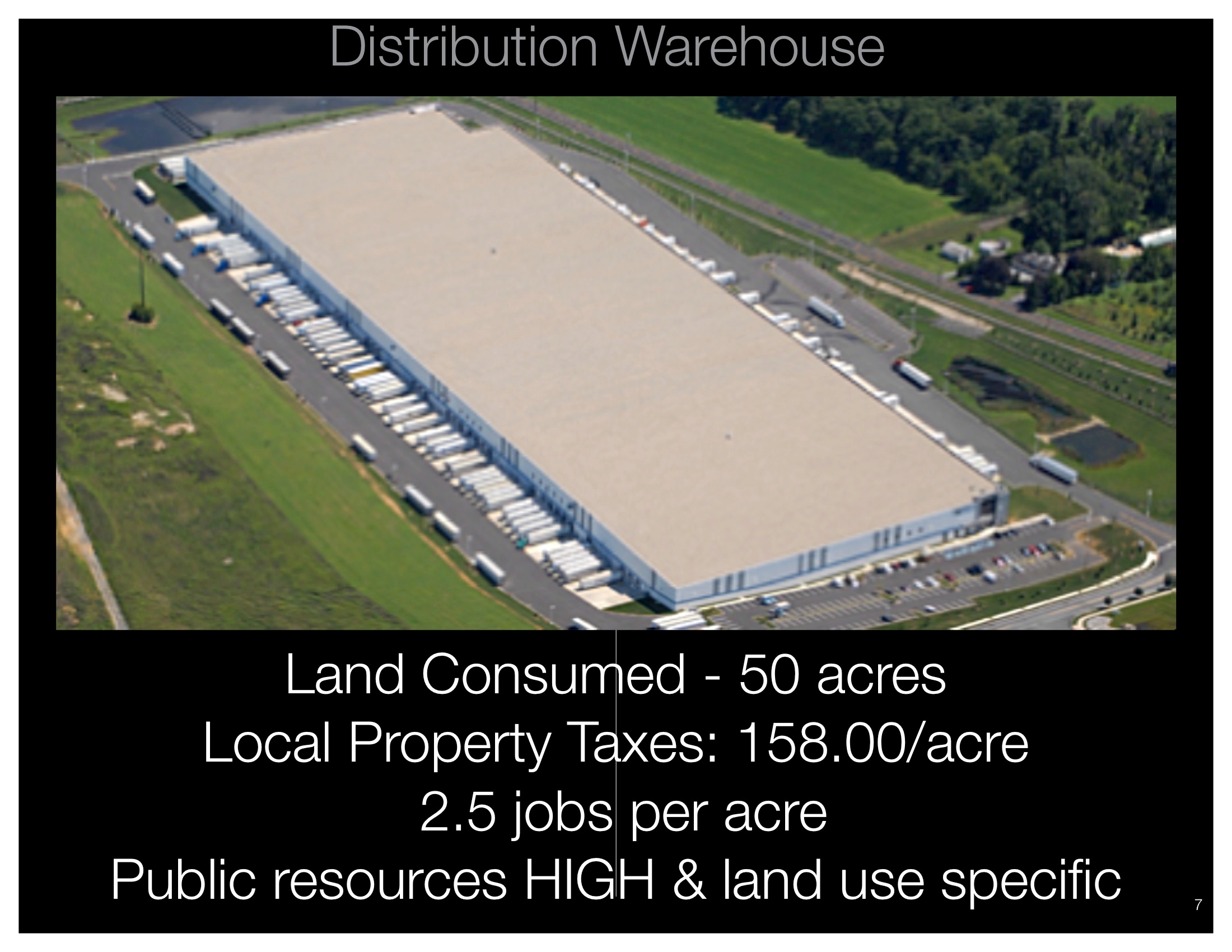
Warehouses do not generate enough revenue to cover the liabilities they create. This includes increased need for police protection, specialized fire equipment, massive road improvements and general wear and tear, and low ROI per acre of land lost.

Warehouses do not generate enough revenue to cover the liabilities they create. This includes increased need for police protection, specialized fire equipment, massive road improvements and general wear and tear, and low ROI per acre of land lost.

To address the long term in 2016 I will propose a full 50% homestead reduction with .50 to .66 mil property tax rate: (the Millage should be increased in conjunction with maxing out the homestead % but more work needs to be done to determine how much)

  • Under proposed .66 mil property tax if you own a home at the township average of around 250,000 dollars your tax liability is 165. (Remember, that is local LMT tax not school or County)
  • Under a homestead exclusion program that grants a 50% assessment reduction on a primary residence the assessed value (for purposes of tax calculation only) is cut in half to 125,000. Therefore the tax bill is also reduced by half to 82.50. (Current level)
  • Meantime Commercial properties such as a distribution warehouses valued at 24,000,000 pays the full assessed value at .66 mil which would be 15,800. This is double the 2014 bill of 7,900.00.

All this is part of a long term plan to address underlying fiscal sustainability. But we have to stay focused. Another part is farmland preservation. Want to lower taxes? Preserve farmland. #saveitorpaveit. Preserving farmland is the number one quality of life issue in the township. By committing to it among many benefits we avoid having to build more infrastructure, provide more services, and we do our part to keep enrollment in EPSD stable.

A way to reduce primary residence taxes. Homestead exception.

Originally Posted March 6, 2014

Last weekend I wrote about factors that forced Lower Macungie to address a budget shortfall this past December. This week I want to focus on one practical mechanism I proposed as a candidate and formally in January that could help address this issue moving forward.

First, it’s important to acknowledge a structural barrier that limits how a township like Lower Macungie can respond to the impacts of sprawling commercial and industrial growth. That challenge will only intensify over time.

Different land uses create different impacts and long term liabilities. However, Pennsylvania’s Uniformity Clause prohibits local governments from taxing residential and commercial property differently unless a specific statutory exception applies. As a result, municipalities cannot directly account for new impacts created by certain types of development through the tax code. This constraint is especially problematic in a township with a large and growing inventory of distribution warehouses that generate substantial infrastructure, public safety, and quality of life demands and may ultimately drive the need for additional police or fire facilities.

This is where smart growth principles come into play.
Greenfield development should pay its own way. Local governments must be vigilant against direct or indirect taxpayer subsidies for land use patterns that fail to generate sufficient revenue to cover their long term liabilities. Too often, municipalities negotiate one time developer improvements or fees without fully accounting for ongoing maintenance and replacement costs over multiple infrastructure life cycles. That approach is both shortsighted and fiscally unsustainable.

Property taxes are also fundamentally regressive.
Regressive taxes are harmful because they place a heavier financial burden on those with the least ability to pay, making it harder for working families and fixed income residents to remain financially stable. Property taxes are inherently regressive. They aren’t based on income, consumption or ability to pay. The property tax often consumes a larger share of household resources for seniors, fixed income residents, and working families. As they continue to rise they can contribute to housing affordability. This is compounded in our area because property values which drive assessments are rising faster than wages or retirement income. When this happens the tax burden grows even when a household’s financial situation does not.

A solution?
A local homestead exclusion is one of the few tools available to municipalities to address this imbalance. In simple terms, it works by lowering the portion of a home’s assessed value that is used to calculate local property taxes. When the taxable value goes down, the tax bill goes down. Because the reduction applies to a fixed amount of assessed value, the benefit is proportionately more meaningful to homeowners with lower or moderate property values and to those on fixed incomes. This helps stabilize housing costs while avoiding shifting the burden of supporting high impact land uses like warehouses onto residents and ensuring homeowner relief is targeted rather than universal.

A local homestead exclusion is a specific exception to Pennsylvania’s Uniformity Clause. It allows a township to provide relief to homeowners. It results in a lower local property tax bill for qualifying homeowners.

This relief applies only to owner occupied primary residences. It does NOT apply to commercial properties, 2nd homes, or investment properties. These properties continue to be taxed at their full assessed value. This ensures that tax relief is focused on people who live in the community full time while maintaining the full contribution from land uses that create the greatest long term impacts and costs.

There are 7 municipalities in Montgomery County who utilize this program on the local level. One example is Upper Gwynedd. An exclusion allows for real property tax relief of up to one half of the median assessed value of homesteads in the taxing jurisdiction. For example:

  • Under LMT’s current .33 mil property tax if you own a home at the township average of around 250,000 dollars your tax liability is 82.50. (Remember, this is the local Lower Mac property tax NOT school or County)
  • Under a homestead exclusion program that grants a 50% assessment reduction on a primary residence the assessed value (for purposes of tax calculation only) is cut in half to 125,000. Therefore the tax bill is also reduced by half to 41.25.
  • Meantime Commercial properties such as a distribution warehouses valued at 24,000,000 pays the full assessed value at .33 mil which would be 7,900.00 dollars.

Its reality that certain types of land uses like strip malls and distribution warehouses hurt quality of life and command the most resources. This is exacerbated when they are located on sprawling former agriculture fringe parcels such as the Jaindl Spring Creek Property which will unfortunately require bran new roads, infrastructure and improvements. Even portions initially funded by the school district and developer will have to be maintained in perpetuity by the township representing an ongoing liability. To me it’s a matter of fairness. Land uses that cause impacts are the ones that should pay for the impacts.

I have asked the Board of Commissioners to consider a homestead exclusion program as one way to reduce the tax burden for primary residences and farmland within the township. This would also allow us to right size taxes on commercial and industrial entities to make sure they are “paying there own way” so that residents aren’t forced to indirectly subsidize them.